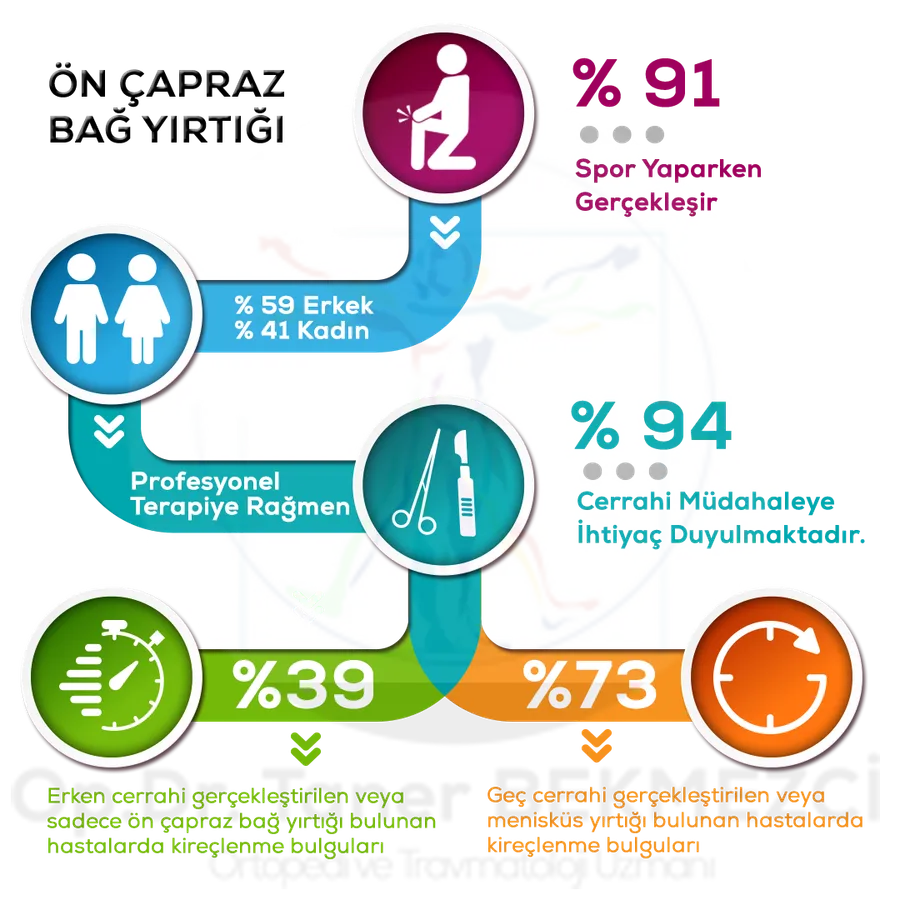
91% of anterior cruciate ligament injuries are sports-related. A significant portion of these injuries occur due to non-contact mechanisms (knee sprain). Seen in 59% of male patients

%91 of anterior cruciate ligament (ACL) injuries are sports injuries. A significant portion of these injuries occur due to non‑contact mechanisms (knee sprain). %59 are seen in male patients, although the injury risk is higher in women of the same age group who participate in sports. (1) In female athletes, the lower incidence of ACL injuries is thought to be related to hormonal factors, excessive flexibility, and an effective jump‑landing pattern. (2,3,4)
Injuries are managed surgically in 60‑70 % of cases. (1,5) 30 % of patients undergo surgery within 3 months after injury, while the remaining group does not rush the timing of surgery. The average time to surgery is 10.1 months. Among athletes who do not receive surgical treatment, 95 % develop meniscus and cartilage problems within 20 years, and 50 % are treated with total knee arthroplasty. (6) In knees treated with arthroscopic ACL reconstruction, patients with isolated ACL tears show 39 % osteoarthritis in the operated knee versus 33 % in the non‑operated knee. (7) Overall, the most important factor influencing treatment outcome in ACL injury is the presence of a concomitant meniscus injury. Meniscus injuries develop over time and determine clinical results. (6,8)
In light of the current scientific evidence, it can be stated that early interventions performed before meniscus problems arise will positively affect medium‑ and long‑term outcomes.
SOURCES
-
- New Zealand ACL Registry Annual Report
-
- Perraton LG, Hall M, Clark RA, Crossley KM, Pua YH, Whitehead TS, Morris HG, Culvenor AG, Bryant AL. Poor knee function after ACL reconstruction is associated with attenuated landing force and knee flexion moment during running. Knee Surg Sports Traumatol Arthrosc. 2017 Nov 28. doi: 10.1007/s00167-017-4810-5.
-
- Herzberg SD, Motu’apuaka ML, Lambert W, Fu R, Brady J, Guise JM. The Effect of Menstrual Cycle and Contraceptives on ACL Injuries and Laxity: A Systematic Review and Meta‑analysis. Orthop J Sports Med. 2017 Jul 21;5(7):2325967117718781.
-
- Fisher H, Stephenson ML, Graves KK, Hinshaw TJ, Smith DT, Zhu Q, Wilson MA, Dai B. Relationship Between Force Production During Isometric Squats and Knee Flexion Angles During Landing. J Strength Cond Res. 2016 Jun;30(6):1670-9. doi: 10.1519/JSC.0000000000001264.
-
- Rahr‑Wagner L, Lind M. The Danish knee ligament reconstruction registry. Clin Epi. 2016;8: 521‑535
-
- Nebelung W, Wushech H. Thirty‑five years of follow‑up of anterior cruciate ligament‑deficient knees in high‑level athletes. Arthroscopy. 2005 Jun;21(6):696‑702.
-
- Hoffelner T, Resch H, Moroder P, Atzwanger J, Wiplinger M, Hitzl W, Tauber M. No increased occurrence of osteoarthritis after anterior cruciate ligament reconstruction after isolated anterior cruciate ligament injury in athletes. Arthroscopy. 2012 Apr;28(4):517‑25
-
- Riccardo C, Fabio C, Pietro R. Knee Osteoarthritis after Reconstruction of Isolated Anterior Cruciate Ligament Injuries: A Systematic Literature Review. Joints. 2017 Jun 5;5(1):39‑43.